
Fiction / Dark fantasy
Walls of Fur
The stone was waiting for him.
Jack could see nothing beneath it. No table, no ground, nothing to explain how it hung at the height of his chest. Light moved inside its dark surface, gathering in the cracks and fading again, slowly enough that he found himself breathing with it.
Behind the stone, something climbed the walls.
He tried to look past it. The movement stopped whenever he looked directly at it, then resumed at the edges of his sight. A soft upward flow. He had the impression of standing at the bottom of deep water, although his clothes were dry and there was air in his lungs.
Something brushed his wrist.
Jack woke with his hand clenched around the sheet.
His bedroom was dark. The box fan rattled in the window. Across the room, yesterday’s jeans hung over the chair where he had left them, and his phone glowed on the nightstand: 4:17.
He sat up and looked behind the chair.
Then behind the door.
Only after he switched on the lamp did he notice how cold his shirt felt against his back.
The logging truck pulled onto the county road just as Jack rounded the bend.
He braked harder than he meant to. Something rolled under the passenger seat of the Ford, and the dashboard gave its familiar loose-metal rattle.
“Sure. Go ahead.”
The truck settled into a crawl. Freshly cut trunks filled its trailer, their pale ends bright against the dark bark. A few branches still carried green fur.
Jack had driven this stretch three days earlier. There had been woods beyond the ditch then, thick enough to make a cool, shaded stretch of road even at noon. Now he could see a yellow machine between the remaining trees. Farther back, another trunk tipped, hesitated against its neighbors, and disappeared.
He reached for the radio. It hissed at him.
The ’76 Ford was older than he was by several decades. Its red paint had faded almost pink across the hood, and the passenger door required a particular lift before it would close. His mother said they should have replaced it years ago. She also got offended whenever anyone else said so.
By the time the logging truck turned away, he was fifteen minutes late.
His mother noticed.
“You look terrible,” she said.
“Good morning to you, too.”
She shifted against her pillows. The movement took longer than it should have. Jack pretended to be interested in the lid of her breakfast tray until she settled.
“Did you eat?”
“Yes.”
“Coffee isn’t food.”
“There was milk in it.”
Her smile lasted a moment. He pulled the chair close to the bed.
For the past three years, the farm had worked around her illness. First they hired help during the busiest weeks. Then Cal began coming regularly for the jobs she could no longer manage. When she was admitted this time, Jack inherited the rest: the calls, the bills, the leaking roof on the equipment shed, the decisions he had always been able to take into the kitchen and set before her.
He could carry seed sacks and move a fallen limb off the drive without much trouble. Sitting beside her bed made him feel useless.
She asked about the crops. He told her they looked good. She asked about Cal. He told her Cal thought the rain would miss them again.
He did not tell her about the dream.
When he glanced at the monitor above her shoulder for the fourth time, she laid her hand over his. Her thumb moved once across his knuckles.
“Sit with me a minute,” she said. “You’re always halfway to the next thing.”
So he sat.
The first patch appeared beside the kitchen doorway.
Jack noticed it while carrying a basket of clean towels upstairs. A little green brush of something, no larger than his thumbnail, growing where the baseboard met the plaster.
He put down the basket.
Up close, it resembled a tuft of very fine fur. The green was bright and healthy, like grass after rain. He crouched and touched it with one finger.
It folded inward.
He jerked his hand back, then felt foolish. Of course it had moved. He had touched it.
A damp cloth lifted it away without leaving a mark. He checked the wall for moisture, found none, and added it to the list of things that needed watching.
That night he dreamed of the stone again.
This time he could see the growth behind it: long green strands lifting and bending in a current he couldn’t feel. They covered most of the wall. Somewhere in the room, out of sight, wood creaked beneath a slow pressure.
He woke before anything touched him.
In the morning, the patch beside the kitchen doorway was back.
Over the next two weeks, Jack found it in six more places.
Behind the coat rack. Along the bottom stair. Around an old nail hole in the upstairs hall. Once, beneath a framed photograph of his grandparents standing beside a tractor, where it formed a green fringe along the frame.
He photographed it with his phone and spent half an evening comparing pictures of household mold. None looked right. The patches had too much shape to them. Each strand divided into smaller strands, delicate as the living branches of coral, and when he opened a window they all leaned together.
The resemblance to seaweed bothered him. The strands moved as though the air had weight.
He scrubbed them away anyway.
Cal found him doing it one afternoon.
“You got a leak?”
“That’s what I’m trying to figure out.”
Cal leaned in from the kitchen door. “Never seen green stuff like that indoors.”
“Me neither.”
“Want me to have a look at the roof when I’m done out there?”
They checked the attic together. Dry insulation. Dry rafters. No stains around the chimney. Cal suggested someone in town who worked on old houses, and Jack wrote down the number.
The man could come the following Thursday.
On Tuesday, Jack cleaned a patch in the upstairs hall before leaving for the hospital. When he returned, it had grown back through the damp smear left by his cloth.
On Wednesday, he stopped wiping long enough to watch it.
He held his hand near the wall without touching.
The fine green tips tilted toward his palm.
He moved his hand to the left.
They followed.
Downstairs, his phone rang. He snatched his hand away so sharply that his elbow struck the doorframe.
It was the hospital calling about a change in his mother’s medication. He listened, asked the questions he could think of, and wrote the answers on the back of an envelope.
When the call ended, he stood in the kitchen for a long time.
Then he went back upstairs and closed his mother’s bedroom door.
It was the room he had been avoiding.
Her slippers still waited beside the bed. A half-finished crossword lay beneath her reading glasses. The air held the faint scent of her hand lotion, and being in there made her absence feel much more deliberate than it did anywhere else in the house.
His grandparents had slept in that room. Before them, his great-grandparents. The furniture changed, but the bed always stood against the same wall, beneath an uneven patch of plaster his mother had promised to fix for as long as he could remember. Jack had never lived anywhere else. He knew the house by the sound of a footstep, and now he hesitated outside its doors.
By the end of the third week, the green growth had reached the ceiling.
Jack opened the door one morning and stopped on the threshold.
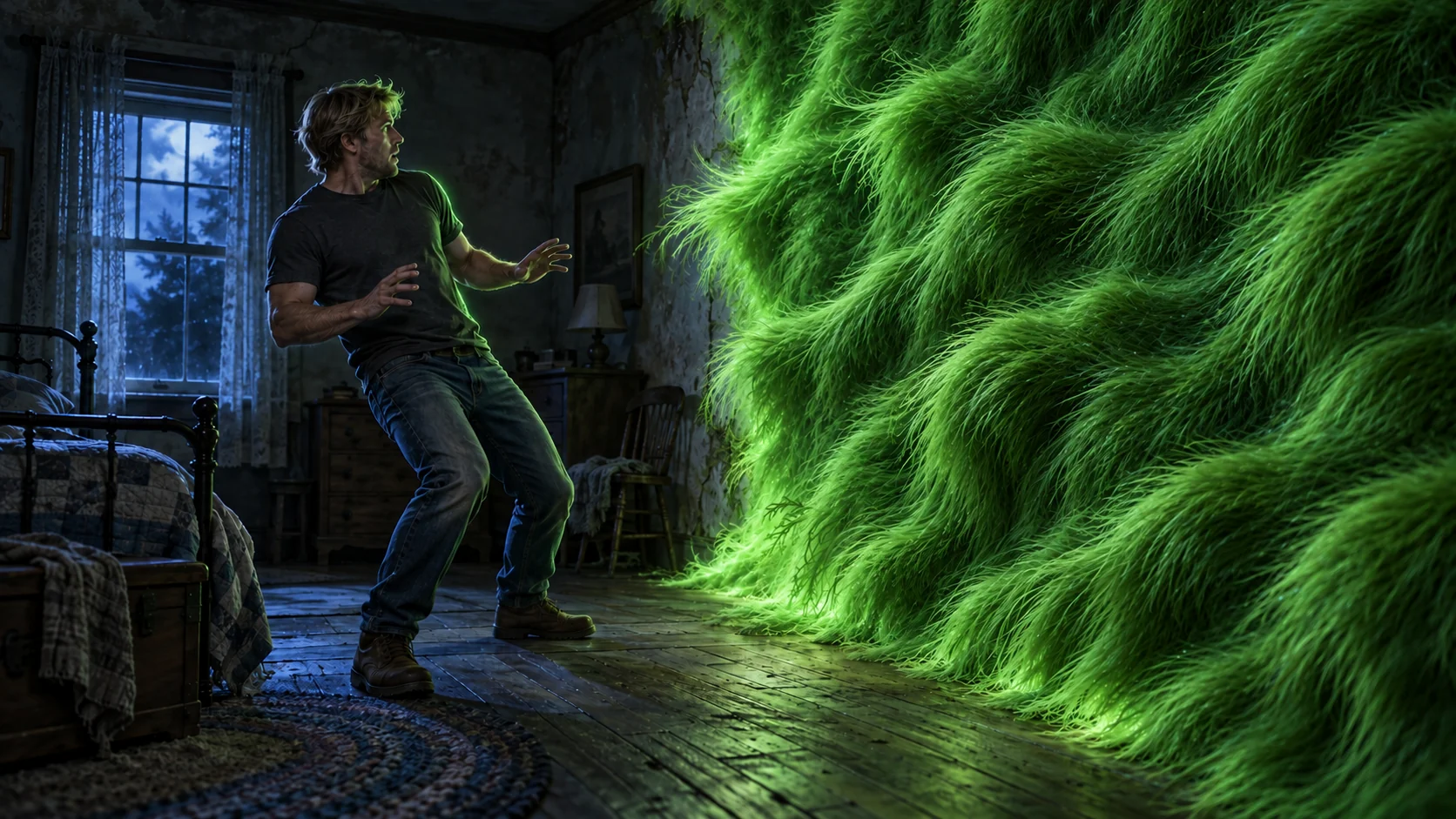
Sunlight came through the curtains. Thousands of fine strands lifted in it, green at their tips and darker near the wall. The whole surface rippled, softly and continuously, although the window was shut.
It was beautiful. That made standing there worse.
He stepped closer.
The growth near his face settled. The rest continued its slow movement around him. He could make out small branching fronds, packed together so densely that they looked, from a distance, like fur.
He pressed his palm against them.
They yielded, softer than he expected. Cool at first, then warm where they gathered between his fingers.
Something shifted beneath his hand.
He felt the movement inside the wall.
Jack backed out and shut the door.
He called the man who repaired old houses and canceled Thursday’s visit. He heard himself say that something had come up at the hospital.
Afterward, he sat at the kitchen table with the phone still in his hand, ashamed of the lie and unable to imagine letting a stranger into that room.
That night, the dream changed.
The stone was still there. So were the green walls. But now a strip of flowered wallpaper showed through a bare place near the ceiling.
Small blue flowers. Yellow centers.
Jack knew that paper.
He had helped his mother strip it from her bedroom when he was twelve.
He took a hammer upstairs before daylight.
At first he tried scraping the growth away. It parted around the tool and gathered again behind it. When he pushed his fingers deeper, he found a crack in the plaster, directly beneath the old uneven patch.
Light showed through.
Jack stood very still.
From the yard came the ordinary sound of a car passing on the road. Someone going to work. Someone whose morning would continue making sense.
He fitted the hammer’s claw into the crack and pulled.
Plaster fell onto his mother’s pillow. Behind it was a small cavity between two studs, lined with wood so dark that it looked burned.
Inside lay a cloth bundle.
The cloth came apart when he touched it. Underneath, a stone the size of a small apple rested in a shallow wooden box. Its surface was dark and smooth, crossed by fine seams of green-white light.
He knew the rhythm of that light.
For several seconds, he could not make himself reach for it.
Then the fronds around the opening lifted toward his wrist.
Jack picked up the stone.
The room disappeared.
He stood among trees so large that the spaces between them felt like rooms. Water moved beneath a floor of fallen leaves. He could feel roots encountering one another in the dark soil, the pressure of new growth, the small lives passing through hollows in old wood.
Then he was somewhere else.
A hand pulled the stone from beneath an exposed root. He felt the astonishment of the person holding it, although he never saw their face. Other hands followed. Darkened by sun, bent by age, small enough to close around only half its surface. The stone traveled wrapped in leather, in woven cloth, in the lining of a wooden chest.
Centuries passed through him with the intimacy of remembered afternoons. By the time he saw a landscape he recognized, thousands of years had gone by.
He saw it carried secretly through a doorway while people shouted outside. Firelight touched a window. The people keeping it were frightened now. There were accusations, the remembered shape of a word: witchcraft. Someone wrapped it more tightly. Someone later hid it without telling their children why.
The room returned for an instant. His mother’s bed. His bare feet in plaster dust.
Then the house was new around him, and a woman he recognized from no photograph was placing the box between the studs.
She pressed both hands against the wall before it was closed.
He felt her promise.
He felt the promises before hers, passed along until the words had worn away and only the keeping remained.
The years accelerated. Woods became fields. Fields became roads. He saw his own farm from above, its straight edges laid across the shapes of old streams. He saw forests elsewhere opening into pale wounds. Smoke spread over treetops. Rivers narrowed. Animals traveled farther for food, then stopped traveling at all.
The stone pushed him forward.
There were futures in which the woods returned slowly. Others in which summers lengthened over empty ground. He felt the absence of birds before he noticed the silence. He saw water that nothing moved beneath, and a tree flowering into air without insects.
He tried to drop the stone.
His fingers would not open.
The yellow logging machine appeared. A fresh cut shone across a stump. Roots still gripped soil beneath it, carrying the sudden absence outward.
The call he had heard in his sleep swelled until he understood it as pain.
“What do you want?”
His voice sounded small in the bedroom.
An answer unfolded through his hands.
Someone to remain. Someone to tend what followed. A living connection to the place where the promises had been made.
He saw himself walking beneath branches that grew through the upstairs landing. He could feel the weather arriving through the ground. At the road, something inside his chest tightened until taking another step became impossible.
Bound to the land.
He understood that much.
But there was another place in the vision, deeper than the one offered to him. He felt the effort needed for the green life to spread beyond the house: a root seeking living soil, unable to reach it. Something had to join it there. Another willing life, taken wholly into the place.
He thought of his mother.
The vision sharpened around her empty bed.
“No.”
The stone’s light continued its patient rise and fall.
“No. You don’t get to ask me that.”
He forced his fingers open and set it on the mattress.
The room became a room again.
Jack staggered into the hall. In the narrow mirror beside the stairs, he saw a pale face, short blond hair sticking up at the back, plaster dust across one cheek. His shoulders filled the old frame. He looked exactly like himself.
He stayed there until he could believe it.
At the hospital, his mother watched him close the door.
“What’s happened?”
He had rehearsed three different ways of telling her. All of them sounded ridiculous now.
So he took out his phone and showed her the video he had made before leaving: the bedroom wall, the open cavity, the green strands curling around his fingers.
She watched it twice.
“That’s my room.”
He nodded.
“And you touched it.”
“Mom. Listen to me before you say anything.”
She listened.
He told her about the dreams. About the wallpaper and the stone, and the things he had seen when he held it. He stumbled over the oldest parts because he had no words for the length of time he had felt, or for knowing a place through every living thing inside it.
When he reached the last part, he stopped.
She looked toward the window. The view was the roof of another wing and a square of empty sky.
“There’s more,” she said.
“It wants someone to stay. To look after it.”
“You.”
“I think so. But it also needs—”
He couldn’t say it. He sat with his hands between his knees, looking at the floor.
She waited until he looked up.
“What happens to the other person?”
“They become part of it. The house. The ground. I don’t know how.”
“Do they die?”
“I don’t know.”
He hated the relief he saw in her face. Hated himself for bringing anything into this room that she could mistake for hope.
“It might be lying,” he said. “Everything I saw. I don’t know what it is.”
She lowered her eyes to the paused video on his phone.
“When I was young, I used to have this feeling. That there would be something I had to give myself to. Something at home.”
“What kind of feeling?”
“I couldn’t have explained it then, either. I thought it meant marriage, or having you. Then your grandmother got sick, and I thought perhaps it was that.”
Her mouth tightened a little.
“It never went away. I just got busy.”
Jack rubbed his palms against his jeans.
“That doesn’t mean this is it.”
“No,” she said. “It doesn’t.”
He was grateful she said it.
They sat quietly while someone rolled a cart past the door.
“I want to see it,” she said at last. “Take me home.”
“You heard what they said yesterday.”
“I heard.”
“And if you get there and change your mind?”
“Then I change my mind.”
She put her hand over his. Her thumb passed across his knuckles.
“You can, too.”
The doctor came in an hour later. He pulled up another chair and explained his concerns without raising his voice. Her condition was still unstable. They were adjusting her treatment. Leaving now could mean getting worse somewhere help would take longer to reach her.
“I’d like you to stay,” he told her. Then he turned to Jack. “And I’d like you to think about what it will be like to manage that at home. You’ve already got a great deal on your shoulders.”
Jack looked at his mother.
She was frightened. He could see it now: the tightness around her eyes, her fingers working a fold of the blanket.
She still said she wanted to go.
Later, the nurse who had brought Jack coffee during the first long night of her admission stood beside the bed.
“Would you give us another night?” she asked. “Both of you could get some rest. We can talk again in the morning.”
Jack almost said yes.
For a moment he could see himself staying in the chair. Tomorrow he would call Cal. Someone would open the wall properly. Someone would take the stone away. His mother would have another breakfast on the plastic tray, and he would complain about the coffee.
His mother squeezed his hand.
“I’ve spent a lot of nights here,” she said gently. “I’d like this one at home.”
They left late in the afternoon, after more conversations. Jack carried written instructions and a bag of medication he was afraid he would forget how to use.
The nurse brought a wheelchair to the entrance. Jack went for the Ford.
“You can call,” she told him as he helped his mother into the seat. “If anything changes, you can call.”
He thanked her. He meant it.
His mother rested a hand on the cracked dashboard.
“Still haven’t fixed that rattle.”
“I’ve been a little busy.”
She smiled, and for the first few miles he could pretend they were simply going home.
He called Cal from the drive and told him to take the next few days off. His mother was home. He wanted some time with her.
“Of course,” Cal said. “Tell her I’ll stop in later in the week.”
Jack promised he would.
Getting her upstairs took almost twenty minutes. They rested on the landing beneath the pencil marks where she had recorded his height each birthday. The last read five eleven in her small, slanting handwriting. He remembered standing there, stretching his neck while she told him to put his heels down.
At her bedroom door, she stopped.
The green had spread across the ceiling and down around the window. It covered the broken plaster on her pillow. Afternoon light passed through the fine fronds and made moving patterns on the floor.
She reached out.
The fur rose to meet her palm.
“Oh,” she said.
Jack brought the chair from beside her dresser and helped her sit. Then he lifted the stone from the bed.
“You don’t have to touch it.”
“I know.”
She held out her hands.
For a while, nothing happened. Her eyes closed. Jack knelt beside the chair, searching her face for pain.
The light inside the stone brightened between her fingers.
She began to cry.
“Mom?”
She lifted one hand. Wait.
He waited.
When she opened her eyes, she looked past him toward the wall.
“I understand what happens to me,” she said.
“Tell me.”
She tried. He watched her search for a way to make it small enough to say.
“I won’t be able to come back downstairs with you.”
Jack bowed his head.
“I could take you back. Right now.”
“I know you could.”
“We could just leave it alone.”
She touched his cheek with her free hand.
“Is that what you want?”
He thought about the empty summers the stone had shown him. About the woman closing the wall, trusting someone she would never meet to remember what she had done. About the yellow machine taking another tree while its roots still reached through the soil.
He also thought about Cal coming up the drive. Buying coffee in town. Driving anywhere at all because he felt like it.
“I’m scared,” he said.
“So am I.”
She did not hurry him.
Outside, the late sunlight moved up the wall. A truck passed on the road, then another. Somewhere downstairs, the refrigerator clicked off.
Jack placed his hands around hers and the stone.
He thought of staying. He let the thought settle, despite the part of him that wanted to run from the room.
His mother tightened her fingers around his.
The floor grew warm beneath his knees.
It happened slowly enough for her to look at him once more.
The fur rose around the legs of the chair and spread across the blanket covering her lap. She watched it with her lips parted. When it reached her hands, the smallest fronds curled between her fingers.
Jack felt water moving beneath the house.
His mother drew a breath. Her shoulders lowered.
“There,” she whispered, as though she had finally found a comfortable place to rest.
The growth gathered around her, fine layers folding over one another. He could still see the shape of her hands beneath it. Then the green lifted in a slow current, and he couldn’t.
He waited for her to speak again.
The light changed. Shadows from the window reached the door. He remained on his knees until the ache in them should have become unbearable, but his body had begun to feel things differently.
At some point, he realized the chair was empty.
The stone lay in his hands.
“Mom?”
The word broke in the room.
He said it again, louder.
The house creaked. Somewhere outside, a bird settled beneath the eaves.
Jack bent over the stone and cried.
Nothing he had seen had prepared him for the empty chair. He had believed her. He had watched her choose. He still wanted to go back a few hours and leave her in the hospital bed, alive and irritated with him for fussing.
His right hand rested on the floor.
A small patch of green rose beneath it, folded over his knuckles, and moved once across them.
He stopped breathing.
The pressure was slight. Familiar.
With it came the sense of being watched by someone who had known him before he could speak. Her presence spread through the room, too large to point toward and unmistakably hers.
He pressed his hand into the green.
For a long time, he stayed that way.
By morning, flowers had opened along the roof.
Small white ones at first, rising between the shingles. Then pale blue blossoms above the porch, their stems trailing down beside the posts. The fur covered the siding in soft green folds. Beneath it, wood that had been cut and nailed into place generations earlier put out thin living shoots.
Jack walked through rooms that smelled of rain and fur. He set the stone back into the opening in the wall, where the growth held it without the box.
The house settled around him.
He could feel his mother wherever the sunlight touched it.
Toward noon, he walked down the drive.
At the old gateposts, his legs grew heavy. Another step brought a hollow pressure behind his ribs. He tried to lift his foot toward the road and found that he couldn’t make the movement mean anything to his body.
He stood there while a car passed. The driver raised two fingers from the steering wheel.
Jack tried to wave back.
The car was gone before he managed it.
He turned toward the house, and the pressure eased.
For a while he thought he could learn the limits.
The green spread through the yard and into the crops. He felt stems giving way, roots entering the spaces between planted rows. The loss frightened him: all the work, all the money, the harvest he had promised his mother would be good.
Then he felt saplings beneath the fur, and a joy that might have been hers or might have belonged to something much older.
He asked the growth to spare the kitchen table.
It curved around the legs.
He asked it to leave the stairs clear.
The fronds drew back.
Those small obediences reassured him.
On the second evening, the house shivered from its foundations to the flowering roof.
Jack put his hand against the wall.
He was suddenly aware of ground beyond the farm: damp ditches, buried roots, the dark strip beneath the county road. The living strands were following something older than the property lines.
At the logging site, green fur climbed a parked machine.
He felt it find warm metal, narrow vents, the seams around glass. Fine threads entered the engine housing. Others thickened beneath the tracks. The machine tilted. A window broke, and the sound reached him through the growth as a small, bright shock.
Nearby, fronds filled the cab of a truck. Roots lifted through its bed, curling around the trunks piled there. The steel frame began to bend.
Jack took his hand off the wall.
He could still feel it.
His phone rang the next morning.
Cal.
Jack answered at the kitchen table.
“You all right out there?”
“Yes,” he tried to say.
The word came slowly. He had to find it among the movement of water and the pressure of roots and a hundred small changes taking place beneath the house.
“Jack? Can you hear me?”
He gripped the phone.
“I’m here.”
“Something’s happened up at that logging site. And there’s stuff coming through the road by the creek. Same green stuff you had on the wall.”
Jack stood.
He felt the creek before Cal finished speaking. The culvert beneath the road had filled with growth. Water was backing into the ditch. Farther on, roots pressed beneath the asphalt, lifting a pale crack down its center.
“Don’t go near it,” he said.
“Is your mom with you?”
Her presence stirred in the floorboards beneath his feet.
“Yes.”
“Put her on a minute.”
Jack closed his eyes.
For several seconds he couldn’t remember how to explain what a phone was for.
“Jack?”
He placed it carefully on the table. Cal’s voice continued, thin and frightened, while Jack went to the front door.
The yard had vanished beneath green.
Beyond it, the road curved toward town, visible in broken stretches between the new growth. He could feel buildings he had entered all his life: the grocery with its cold brick wall, the repair shop with oil deep in the concrete, the little diner where his mother always ordered pie to take home.
The fur was climbing their foundations.
People moved along the sidewalks. Doors opened. Cars stopped where the street had begun to lift. Jack felt their footsteps through the ground, quickening as green fronds emerged from the cracks.
He pressed both palms against the porch rail.
“Stop there.”
The growth nearest him settled.
In town, a root entered the wall of the diner.
“That’s enough.”
Flowers trembled above his head. His mother was close, and he reached for her with a desperation that made the whole porch stir.
He had understood the empty chair. He had understood the gateposts, and the crops, and the long life waiting for him inside the house.
He had thought those were the things he was giving away.
From the kitchen, Cal was still calling his name.
The green curled over Jack’s hands and stroked his knuckles once.
Beyond the bend, the town’s first stop sign leaned, slowly, into the fur.
— End —